Cody, S., & Greene, C. (1997, January 16). Seymour Papert: Learning through building and exploring—The Multimedia Today interview. Multimedia Today (IBM).

The MULTIMEDIA TODAY: Interview
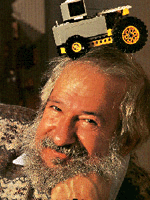
Seymour Papert:
Learning through Building and Exploring
“When you’re tied down to a 19th-century concept of what you’re doing, it doesn’t put you in a good position to use 21st-century tools”
Seymour Papert believes that building things helps people learn. As the LEGO Professor of Learning Research at Massachusetts Institute of Technology, Papert should know. Yes, LEGO—as in building blocks, as in kids, as in play.
Papert has been called “the greatest of all living education theorists,” by no less than Marvin Minsky. In two recent exclusive interviews with MULTIMEDIA TODAY: , Papert expanded on his theories of how technology can help kids learn through building and exploring. “We should think of the computer as what you make something out of, or as a medium that gives you the opportunity to express yourself and access what other people have expressed,” Papert said.
In addition to using the computer as a tool for expression and building, Papert sees much promise in using the computer for exploring. “I would like for us to recover the image of learning we see in very young children—learning by exploring the world,” Papert said. “I think scientists and creative people learn like children do. Learning should be about becoming more skilled at exploration, detached from the right and wrong.”
As a founding member of the MIT Media Laboratory and director of its Epistemology and Learning Group, Papert pioneered the computer language LOGO and has written two groundbreaking books on learning: Mindstorms: Children, Computers, and Powerful Ideas, and The Children’s Machine: Rethinking School in the Age of the Computer.
Papert has several learning projects going on in places as diverse as Bucksport, Maine and Johannesburg, South Africa. He recently managed to stay in one place long enough to spend over three hours with MULTIMEDIA TODAY: contributing editor Suzanne Cody. Associate editor Cynthia Greene produced this first of two edited interviews:
MULTIMEDIA TODAY: I would like to get some definitions from you to start with: first, literacy, and then your own term “letteracy.”
SEYMOUR PAPERT: Literacy refers not just to being able to read, but to having taken in a whole culture around reading, a culture which usually comes through reading.
With multimedia, the role of the written word may become much less important. In the future I suspect we will be less likely to associate people who are educated with people who have the ability to read books; someone who hasn’t read a single book might be an extremely well-informed and culturally rich person. I think we need to make a distinction between the connotation of literacy that has to do with cultural richness and the connotation of literacy that just has to do with print medium.
To make this point I’ve introduced the word “letteracy,” which refers to a very special knowledge about letters as distinct from the richer knowledge which is what we really care about. These two meanings are evident when people talk about computer literacy; by computer literacy they mean that you know a little bit about computers and yet if somebody knew just that little about books, you’d say they were illiterate. So computer literacy means just knowing the mechanics of something, and not even very much of that.
MULTIMEDIA TODAY: So rather than the term computer literacy, could you use the term “information literacy?”
SEYMOUR PAPERT: The phrase “computer literacy” has such a devalued meaning by now that it’s almost impossible to rescue it. I’ve been using the term “technological fluency.” I don’t think we have language yet for talking about the kind of knowledge people have about or through these new technologies.
Say someone is fluent in French. This doesn’t mean that the person knows some facts about French, or even a lot of facts about French. What it means is that this person can really use French as a medium of expression; if they’ve got an idea, it comes naturally to say it in French. Because the language becomes almost an extension of yourself, you don’t have to think, “How do I say this in French?” It just comes out in French.
I see the same thing in relation to technology. When people become “technologically fluent” the technologies become part of their way of thinking, of how they express themselves.
MULTIMEDIA TODAY: Do you think the print associations of literacy will eventually just drop from the language?
SEYMOUR PAPERT: It’s very hard to know what’s going to happen to words, but yes, either the meanings of these words are going to change, or the words will become much less used. Going back to literacy, talking about somebody being literate, I think the meaning will just extend to other media and we’ll begin to use the word in the essence of its meaning—not that you can read and write, but that you’ve taken in a lot of knowledge and can think fluently in terms of metaphors from literature, poetry, and history—that you can use this knowledge and are able to express it in the way that you think.
MULTIMEDIA TODAY: Let’s say the last 20 years have been about attempting to make people computer literate, would you say the next decade or so will be about making them “information fluent?”
SEYMOUR PAPERT: Maybe, yes. When I see kids at their computers, their fingers flying over the keyboard while they hop all over the Internet—I call this fluent. They’re using all that technology and everything that’s behind it the way you’d use a language in which you were fluent.
MULTIMEDIA TODAY: Can you pinpoint three major problems with education in this country today, and then, alternatively, three things that you think we’re doing right?
SEYMOUR PAPERT: Let me play on your words for a moment . . . what are “we” doing right? The biggest problem in education is that it’s thought of as a collective, centralized thing. The best things are not being done by we in the general sense, but by individual teachers, individual schools, individual writers.
Education in this country is a centralized command system, rather like the Soviet Unions was. There they tried to run an economy by making decisions in a central place and applying the same criteria and standards to everybody. It collapsed because it couldn’t work.
In this country we take much the same approach. We think of creating national standards. We think of creating a curriculum that applies to all people. More than 99 percent of our schools divide kids into grades, each level teaching the same subjects. This centralization and uniformity is poison, and it makes it almost impossible for serious innovations to be tried.
On the local level, centralization means having a committee decide what the curriculum should be, what should be taught at each age, what education should be given to everybody. I don’t believe some people should get an inferior education, but there should be choices in the type of education you can get. Educators talk a lot about choice, but it reminds me of Henry Ford—you can have a Model T in any color you like as long as it’s black. You can choose anything you like in school as long as it’s what everybody else is choosing.
This idea of uniformity is the worst thing, but alongside it is curriculum that was decided upon many, many years ago. Most of what we teach in mathematics is totally irrelevant to the world. There is no reason why children, why anyone, should know how to multiply fractions. I bet you’ve never multiplied a fraction in your life outside of school?
MULTIMEDIA TODAY: Never.
SEYMOUR PAPERT: If once or twice in your life you had, it still wasn’t worth all the effort and money that was spent on programming you to do it. Remember my story about time travelers from the beginning of The Childrens Machine? [see sidebar, “Time Travelers”] That somebody from the eighteenth century would recognize our schools today and understand what’s going on there suggests that something is very wrong.
MULTIMEDIA TODAY: Because the curriculum hasn’t changed?
SEYMOUR PAPERT: Not just the curriculum, the whole system hasn’t changed. Changing the curriculum is one component of it, but why should children be segregated by ages? Why do we even have this idea of people of one age spending most of their time together in a classroom? Children learn better and are able to develop a lot emotionally in very mixed-age families before they go to school.
There’s no reason to segregate them by age except that we’ve always done it. Remember, school was structured for the primitive technology of knowledge that existed before the last few decades. Prior to modern technologies for giving people access to knowledge, the only way to impart knowledge was to cut it up into little pieces and dish it out.
MULTIMEDIA TODAY: And some of the best things about schools?
SEYMOUR PAPERT: The movement for alternative schools, an individual school with a few teachers and a few kids, is the best thing that’s happening on the education scene in America. It’s very small scale a few schools following their own educational track because the people there believe in it but it’s happening. I think the home schooling movement is very good, and that it’s going to grow as new technologies allow kids to access knowledge without going through bureaucratized school systems. Also kids getting together for music, computer, or rock climbing camps these are much better models for good learning than a classroom. Kids obviously need guidance from adults, but adults should be driven by their own personal philosophy of learning, not by curriculum decided upon by a committee.
MULTIMEDIA TODAY: What is the point of having a curriculum?
SEYMOUR PAPERT: I think there’s not only no point in it, but that it does incredible harm. It turns the teacher into a technician whose job is to hand out facts, not someone whos in a human relationship with students, someone whose job it is to help students develop their interests and minds.
There is a looser sense of curriculum, though that there are certain things it is important for people to know, things that aren’t really facts. There are no important facts. What I mean is that an attitude, again, a fluency, is important to be able to use knowledge technologies fluently to access knowledge when you need it the way one can use language fluently. It would be nice to have a word, something like “factuacy” to put the emphasis on fluency rather than on facts.
MULTIMEDIA TODAY: What should the role of government be in a changing model of education?
SEYMOUR PAPERT: The role of government should be to encourage diversity; it should make the means available to do research to develop alternative models, and it should help apply resources to make diversity happen more easily. In other words, I think government should have a facilitating role and not a regulatory one.
I complain about antiquated curriculums, but if somebody said to show them what I’d really like to put in their place, I could only supply the bits and pieces. It’s an enormous job to develop the whole range of materials you would need. Books, computer programs, content it involves a lot of work at a level that should be funded by government.
MULTIMEDIA TODAY: What should the role of corporate America be as education is diversitized and maybe privatized?
SEYMOUR PAPERT: Well, I can see two roles. There has been a good healthy tradition in America of business giving funding for educational innovation. I think over time I’ve had about equal amounts of support from government agencies and from business. IBM has given several million dollars supporting the work that I’ve done; the LEGO company has given a bit more and other companies have given a bit less.
I believe these enlightened businesses see that it’s in their interest to support innovative research. They are examples of companies doing what government should do. This is particularly true of IBM they didn’t give the money expecting some product back from me. They might have hoped their support would encourage the use of computers and that they might benefit from that, but that benefit was by no means either direct or a given. I think this is a very healthy thing.
As to the question of privatizing education, it’s inevitable. There’s going to be more and more privatizing of education it isn’t a matter of choice. Given the role of new technologies and a wider acceptance of diversity in society, private enterprise will take initiatives that public schools have been just too timid to take. This is an altogether good thing. The concept of public education is a precious one, but it hasn’t worked and I don’t see how it’s going to work. If somebody could save it, I’d like to see it saved, but I think we’re going to see public education replaced by privatized education.
MULTIMEDIA TODAY: There’s a grassroots movement to provide vouchers for alternative education. What do you think of providing parents with taxpayer financed vouchers to educate their children in alternative ways?
SEYMOUR PAPERT: I think in principle it’s a very good thing to do the government or states or cities providing people with the resources to buy education. In principle, yes, I think governments could provide people with resources to support their children’s individual education.
MULTIMEDIA TODAY: Obviously the goal in this country should be to improve learning but rather than tinker around with things, should we simply level the Department of Education and start from scratch?
SEYMOUR PAPERT: Yes, good point. Maybe we should turn the Department of Education into a Department of Learning a place whose function would be to encourage learning rather than regulate education. It would be very nice to have a department of the government whose function it was to encourage learning, to protect it, to do the things necessary to foster good learning, and to support people who are trying to improve learning. Maybe they could regulate people who are encouraging bad learning, or discouraging learning.
MULTIMEDIA TODAY: Maybe there should be an amendment in the Constitution giving us all the right to learn.
SEYMOUR PAPERT: I’m with you, do you want to organize this?
MULTIMEDIA TODAY: We can set up a grassroots movement!
SEYMOUR PAPERT: Actually, there is a widespread movement that says learning has not received enough attention. Learning isn’t confined to schools anyway it also happens before and after you go to school. The central problem in our economic system may well be associated with learning. A lot of people who have tried restructure the economic system find that the major block is that people are either reluctant or find it too difficult to find new ways of doing things.
I think this happens when companies don’t foster good conditions in which to learn new ways of doing things. They don’t approach the problem of learning in a flexible, modern way. You can’t teach people everything they need to know. The best you can do is position them where they can find what they need to know when they need to know it.
MULTIMEDIA TODAY: In the late ’80s you proposed a genre of writing called computer criticism. By comparison to literary or social criticism, it’s in it’s infancy, but it’s helping us begin to grasp the human and social implications of the computer’s presence in culture, and computers as culture. Do you think that society is beginning to grasp these implications, or do you think we’re still lagging on this issue?
SEYMOUR PAPERT: I think we’re still lagging, but the fact that somebody like you is working for a magazine in a technological area is an example of how, while we might be lagging, something’s happening. There is movement. From the way you’re talking, what you’re trying to do is exactly that write about technology.
MULTIMEDIA TODAY: And doing more than writing about technology, but taking technology and putting it in a human forum, so people can relate to it in a human way.
SEYMOUR PAPERT: Yes, that’s right.
MULTIMEDIA TODAY: What developments with respect to educational technology would you like to see in the next decade, and then more realistically, what do you think we’re likely to see?
SEYMOUR PAPERT: Often, I would start off a discussion like this by saying I really don’t like the word education.
MULTIMEDIA TODAY: Maybe “learning technology”?
SEYMOUR PAPERT: That’s better. The first important thing about educational technology is to replace it with learning technology. The shift from a technology of teaching to a technology of learning is an important trend we should encourage. We should look for signs of it and push them as hard as we can. For example, I really like the Edmark software, Thinkin’ Things it isn’t dominated by an instructional kind of feeling.
MULTIMEDIA TODAY: Do you think CD-ROMs and software titles encourage creativity and interactivity?
SEYMOUR PAPERT: Interactivity bothers me in and of itself. What’s two plus two? Five. No, try again. That’s interactivity and I think it’s bad. It involves the use of a computer in a way that’s too intrusive and is dominated by the idea of a right answer. I think some of the best stuff isn’t interactive.
Would you say that LEGO, building with LEGO blocks, was interactive? I wouldn’t. I’d call it constructionist. You can build things with it. You can fantasize and then make your fantasy; you can imagine some strange structure and then create it. Paint, pencils, drawing, and paper are the same sort of thing. But interactive isn’t a good word for them.
And I think the same is true of computers. We’ve been seduced by this idea of interactivity. You wouldn’t call a book where you could open the next page, or even pop-out books, interactive. Maybe “active” is a better word.
Interactivity conjures up a sense of reaction I do something, you react, I react, etc. This makes the computer too much the active agent rather than the medium or the material. We should think of the computer as what you make something out of, or as a medium that gives you the opportunity to express yourself and access what other people have expressed.
I really believe medium and material are better metaphors than interactivity. It’s just much easier and cheaper to make right/wrong software. Unless the concept of learning in our culture changes, we’re going to continue to see right/wrong software.
This goes back to our conversation about placing technology in the context of larger human, social, and cultural issues. To talk about trends in software beyond tomorrow, you’re really getting at trends in how people think about themselves, their children, society, and learning. I think change is possible. If our society changes it’s thinking about learning, it will profoundly affect the market for software. People will think a different kind of activity appropriate for their children and will then want a different kind of software.
MULTIMEDIA TODAY: Could you elaborate for me on what you think a constructive new perspective on learning would be?
SEYMOUR PAPERT: I would like for us to recover the image of learning we see in very young children learning by exploring the world. I think scientists and creative people learn like children do. Learning should be about becoming more skilled at exploration, detached from the right and wrong and the given propositions like that the Battle of Waterloo took place in 1815, and that 3 times 7 is 21. These are propositions. Some knowledge goes into propositions, but it’s the knowledge that’s least important because it’s easily accessible in encyclopedias or databases.
Ideally, propositional knowledge would be devalued and fluency would be more valued. People give lip service to learning to learn, but if you look at curriculum in schools, most of it is about dates, fractions, and science facts; very little of it is about learning. I like to think of learning as an expertise that every one of us can acquire.
MULTIMEDIA TODAY: Do you think technology can help us begin to think differently about these issues?
SEYMOUR PAPERT: Absolutely. Technology makes it possible for kids to have access to knowledge when they need it, and it provides them with an opportunity to use this knowledge.
Imagine giving kids computer tools to make their own video games. Video games are interesting, and given the chance, most kids would love to make their own. In the course of doing so they would learn an incredible amount of other stuff, including the math involved in calculating the timing of events and the speed at which things could move. From this technological base, they’re also learning design and computer programming.
The computer becomes a material out of which you can make a game. From this material you can make something that you simply couldn’t make from wood or sand.
MULTIMEDIA TODAY: Do you still think that technology can support the megachange you spoke about in The Childrens Machine?
SEYMOUR PAPERT: I think technology makes that possible, yes. Is technology sufficient in itself to induce it? No, very much no. Technology unfortunately also makes possible the opposite new heights in the right/wrong approach to education. Technology can, howe’ver, give us much more choice than we ever had before, and we can exercise that choice in different directions.
MULTIMEDIA TODAY: In the past few years some have said that the Internet and the World Wide Web have grown so much that the global network can be regarded as a computer, with individual PCs as windows into this big computer.
SEYMOUR PAPERT: If you start with the technocentric question of how can global networks be used for learning, you get bad answers. What we should be doing is developing a philosophy of learning and then asking how global networks can be used to support it.
With the kind of learning I think is important, the kind where the most important thing is carrying out projects or accessing the knowledge you need to answer your curiosity, being able to communicate across the world offers fantastic opportunities. To be in touch with other people who have the same interests and can help you ahead to the next layer of problems this aspect of global networking can radically transform learning opportunities.
Classrooms are very artificial learning communities. The chance that some other kid in your classroom shares your interests is very small; the chance that somebody in the world does is very high. If you can get together with the people who think like you and share your interests, your learning will skyrocket because you’re able to follow through on what you care about and can do well.
MULTIMEDIA TODAY: Given a global network, do you see a continuing role for “the school”, a place which presupposes that people should be grouped all day long in a shared physical space?
SEYMOUR PAPERT: I do think getting together physically is important.
MULTIMEDIA TODAY: But can this be better provided through other mechanisms, like neighborhood and community interest groups and camps rather than through school?
SEYMOUR PAPERT: Undoubtedly. You know when I talk about how bad I think school is, and how much damage I think it does, people always say it has an important socializing function. There are a lot of ways to reply to this, the most devastating of which is one you mentioned. If you were to set out to design an ideal situation for children to develop social skills in, would you choose teaching fractions as a way to do that? Obviously not.
Some social development happens in school because kids spend all their time there and they make friends, but it happens despite school, not because of it. I think what schools think of as their main function, providing access to knowledge, learning skills etc. will happen more through computer channels, through networking, software and so on.
MULTIMEDIA TODAY: Five or ten years from now, how will the increased power of global networks directly benefit learning? Do you think these networks will be best used from schools, the home, or the workplace?
SEYMOUR PAPERT: They won’t be best used in schools. They’ll probably be best used by individuals who have found their best way to use them. Within that, I see a proliferation of new forms of association for learning -community centers, interest groups, hobby groups- these sort of places will make very good use of global networking. Who knows, I’d like to think schools can change some are, but it’s a minority. When you’re tied down to a nineteenth-century concept of what you’re doing, it doesn’t put you in a good position to use twenty-first century tools.
MULTIMEDIA TODAY: What about multimedia? Some see it as providing a more direct means of delivering learning content to students; others see more potential in putting multimedia tools into kids hands to help them communicate information better. Is either way effective?
SEYMOUR PAPERT: Certainly the second is more important than the first. As a way of delivering stuff, well maybe, but that’s not what learning is about. As a medium, putting multimedia tools in the hands of kids can help them become fluent in the same way that putting paint in their hands differs from just delivering paintings to them.
MULTIMEDIA TODAY: But is that superior to giving them a crayon?
SEYMOUR PAPERT: Well, it’s not superior to giving them a crayon -they should have a crayon, too. I don’t want to displace crayons. With multimedia you can do more stuff. It’s more like giving a child a crayon than giving them a math worksheet. Multimedia shouldn’t be for delivering facts; it should be for giving someone a creative medium.