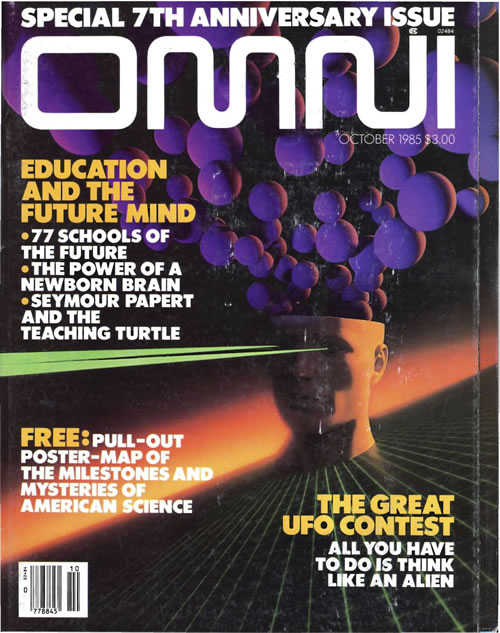
An interview with Seymour Papert by Ron Schultz. Originally published in Omni magazine.
The computer is a bridge between abstract and concrete, intellect and emotions, child and adult, says this father of artificial-intelligence research.
Biography
The son of a South African entomologist, Seymour Papert spent the first years of his life in the jungles. It was in those African camps that he discovered his first passion: automobile gears. Crawling under the heavy camp trucks, the child became fascinated by the movement of the meshing teeth, the relationships of the rotating large circles, and how they were affected by the smaller gears. It was Papert’s first experience with numbers and mathematics.
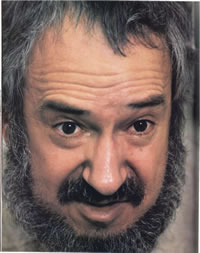
In high school Papert became similarly fascinated with logic and was permitted to attend logic seminars at the University in Johannesburg. He went on to study philosophy at the University of Witwatersrand, but he soon took up mathematics and earned a Ph.D. in the field in 1952. And he continued to be preoccupied with how symbolic thinking evolves in individuals. His first connection with a computer of any sort was in 1945, when there weren’t really any computers. “I got into a debate about the possibility of mechanical thinking,” he recalls, “and built a little computer that was inspired in part by this philosophical debate. I was emotionally involved with computers but didn’t think of them as educational things.” (He also ran track — the 100-meter dash. “There was a time,” he says, fingering his gray beard, “when I even thought of taking it seriously. I think fortunately I damaged my knee and shortened my career.”)
He later earned a second doctorate in 1959, in mathematics, at Cambridge University in England. He went to Great Britain’s National Physical Laboratory to do research in mathematics and cybernetics, the study of artificial thinking. It was during his stay in England in the late Fifties and early Sixties that Papert met artificial-intelligence (AI) researcher Marvin Minsky at a symposium. Soon thereafter he was invited to the United States by famed cyberneticist and neurophysiologist Warren McCulloch. But at that time his anti-apartheid political activities were considered threatening to the stability of the United States, and his American visa was held up until the mid-Sixties.
Today Papert is a professor of mathematics and education at the Massachusetts Institute of Technology, and together with Marvin Minsky, he cofounded MIT’s Artificial Intelligence Laboratory. Papert, one of the world’s leading authorities on learning, is considered “high priest” of computer education. Eighteen years ago he created Logo, the computer programming language most widely used by young children. His book Mindstorms: Children, Computers, and Powerful Ideas has considerable influence among educators everywhere.
At least part of Papert’s success can be traced back to a meeting in 1958 with the great psychologist, mathematician, and epistemologist Jean Piaget. At that time Piaget was already achieving global recognition for his studies on how children think. Until meeting Piaget, Papert had seen himself as a mathematician studying mathematics. But Piaget’s notion about children using simple concepts, building-block style, to understand more complex concepts took Papert back to his childhood gears.
Papert realized that Piaget was really trying to do the same thing that AI researchers were after: to formalize modes of thinking other than the hierarchical “correct thinking” of the logicians. But according to Papert, Piaget lacked an appropriate model for working out these formulations. Piaget didn’t care to know about computers. But Papert saw the computer as a perfect model. Piaget’s ideas would grow to become the basis for Papert’s unfolding universe of computer “microworlds.”
Designed as benign intellectual environments where children can think creatively and form and test their theories, microworlds are for Papert the keys to education. Like Piaget, Papert believes that in all learning, “you are essentially concerning yourself with little pieces of reality, and by looking at these little pieces you can understand the complexities of a bigger world.”
The electronic land of the Logo Turtle is Papert’s most famous microworld. The Turtle is a triangular-shaped figure that he calls “a cybernetic animal that exists within the cognitive miniculture of the Logo environment.” The little creature on the screen serves no other purpose than “being good to program and good to think with.” Children “talk” to it to get it to move by typing instructions at a computer terminal. And as it moves, the Turtle leaves a track on the video display terminal. With the Logo Turtle, a child can draw anything from squares and circles to complex pictures.
Like Papert’s gears, the Turtle initiates children into the world of mathematics and learning in ways that are fun and enlightening. Logo, he says, aims to teach children to be mathematicians rather than to teach them about math — to be physicists, or medical doctors, or writers. The idea of Logo, says Papert, does not go beyond what is common in today’s schools, “It goes in the opposite direction.”
Research in the Artificial Intelligence Lab in the late Sixties led to the founding in 1970 of the Logo group. With colleagues from the lab and elsewhere, Papert formally put together his ideas of education and computation. One of the driving forces of his philosophy is the idea that through the use of computers children gain a sense of self-motivation, of taking charge of their own learning process. But Logo serves adults as well, he says, like a natural language that conveys the needs of toddlers, yet also satisfies the purposes of poets and philosophers.
Papert has been described as the archetypal absentminded professor, a man who once discovered halfway across the Atlantic that he had left his wife behind in a New York airport. He’s also impish, charismatic, intuitive, thoughtful, and childlike in his enthusiasm for his work. His MIT office is the new Media and Technology Lab, where green, yellow, red, and black tiles dot the white walls to create what looks like a giant Mondrian canvas. Papert’s lab has its own small daycare center surrounded by computers and offices. Although he has no car, he plans to buy an airplane. “Flying is an incredible combination of so many worlds that come together to make it possible,” he says with a gleam in his eye. “There’s this reliable engine turning. The shape of the plane, the understanding of the magic of aerodynamics — it makes me feel continuous with Leonardo da Vinci.”
Ron Schultz caught up with Papert while the scientist was rushing to MIT appointments, flying around the East Coast, and pausing at his Boston apartment.
Interview
On Piaget
Omni: How did your encounter with Piaget revolutionize your thinking?
Papert: When I met Piaget my passion for understanding mathematics came together with my desire to know how the mind works and to create a theory of intelligence. Piaget fascinated me because he managed in the same breath to say something both about the nature of mathematics and issues fundamental to philosophy — and at the same time discuss how children think about mathematics. This is amazing, and it’s an aspect of Piaget that is totally unappreciated by his American followers. They see him as purely a psychologist, not as a philosopher and epistemologist [one who studies knowledge]. They don’t know anything about fundamental mathematical issues and don’t think they are important.
People interested in the psychology of education or the psychology of how children learn mathematics generally focus on superficial aspects of math. How do children do the manipulations of addition or misunderstand the laws of physics? For Piaget, the deeper nature of mathematics is fundamentally relevant to understanding children.
Omni: Was there a moment when Piaget said something that altered your perception?
Papert: Of course I’d known about Piaget before I met him. In fact, just about a month before I met him I had quite a violent fight with a friend about how bad Piaget was. Until I met him I focused mainly on the Piaget who speaks about what children can’t do — they can’t learn this or that because they are not yet at the right stage. At our first encounter Piaget asked me what I thought about [English mathematician and philosopher] Bertrand Russell. The conversation became a debate about an argument between Russell and [French mathematician] Jules-Henri Poincaré. Somehow Piaget brought children into it, and I thought, What does this have to do with a child? It suddenly seemed very heroic, and not only was Piaget being the hero, but so was the child! That he brought children into a debate about philosophical puzzles opened my eyes. Lots of things came together. A month before that I’d seen Piaget as the structural theorist of what children can’t do, and suddenly there was this person who wasn’t restricting but was promoting the child to a philosopher.
On Microworlds
Omni: How much of your work grows out of the idea of microworlds? What are they?
Papert: Let’s look at an example. Perhaps the decisive point in Piaget’s thinking was his book on number. For him, number emerged from the simplest and most intelligible structures, which he sometimes called the mother structures of numbers. These are, say, ordering, algebraic combinations, and topological relationships. Ordering just means putting things in order relationships, and topological means inside and outside. Piaget sees the evolution of number as perfecting these mother structures. The child is not working on number but on something much more elemental and simple, like order, or even inclusion and nearness. These structures, which I call microworlds, develop separately. Only when they are firmly rooted can they coalesce and enable something as complex as number to emerge.
On the Turtle
Omni: So why a turtle?
Papert: All these microworlds are naturally occurring. Piaget didn’t invent the order structure; he noticed that children had always used it. As long as people had hands and eyes, they could place objects in sequence, and I suppose babies did this in Paleolithic times. I was thinking that innovation in education should create artificial microworlds. I groped around with a lot of them. The Turtle caught up in my mind as a paradigm of a microworld to be invented. It couldn’t occur in the natural development of children’s intelligence — as the ordering microworld could — because the Turtle requires a computer. But children can identify with it because it moves as they move. It makes sense in terms of what is most central to their thinking, namely themselves.
Omni: What was the mathematical concept behind the Turtle?
Papert: In the history of geometry, Euclid takes the point to be the fundamental entity. It has neither magnitude nor color, shape, or smell. A point is an entity reduced to just one property — position. That is what gives it its cleanness and made it the basis of Euclid’s entire mathematical system. A Turtle is not quite such a reduced thing — it has position and heading. It is like a point that faces in a particular direction. From the point of view of anthropomorphizability, you could think of yourself as a turtle or you can think of yourself as a point. For you to move, you have to have a heading and direction, so you have to be more like a turtle than a point.
Grey Walter, an English cyberneticist, once made a mechanical tortoise. For Walter, the tortoise was a totally programmed little object that moved around the room. When its power was running low, it could detect this fact and look for the place to plug itself in and recharge. The Turtle was to be like that tortoise except the Walter tortoise had a rigid form of behavior, like an insect. My Turtle is a malleable creature. A child can give it any behavior it wants to. A turtle is a cute animal. Children seem to like it. It crops up a lot in mythology. It moves in a slow and deliberate way. In all sorts of ways, it’s an attractive thing. For me, it’s a poetic image.
Omni: Children have made very profound discoveries with Logo, such as their own personal discovery of the number zero.
Papert: That’s a touching example of the kind of intellectual nugget that you find in this kind of microworld. A kindergarten girl had been playing with a Sprite, a Turtle that can be given a speed. At speed one hundred, it goes whizzing past. Set at speed ten, Sprite goes very slowly. At speed one, you hardly see it move. Set at speed zero — it stops. The girl became very excited about that. She had suddenly realized that standing still was moving with a certain speed, namely speed zero. This means that zero is a number, as ten, one hundred, and negative ten are numbers. Greek mathematicians did not know about zero. Hindu mathematicians discovered it sometime later. What does it mean to discover zero? The experience of this girl shows there was something deeper than using a symbolic circle to represent it.
Omni: Why is the Turtle microworld a safer environment for learning than a traditional school situation?
Papert: For many children traditional school is a very dangerous place because you can be humiliated, embarrassed — scared of being found out that you don’t know how to do something. Whereas with the Turtle, you can play with it by yourself. It’s okay that you don’t understand it because you found out that you didn’t understand it. You wanted the Turtle to do something, and it did something else, but understanding why it did its thing is the proper way to lead you into having it do your thing. You don’t have to think that you are stupid; you can think, this dumb Turtle, if you like. There is a kind of human quality about being able to interact with the Turtle when things go wrong. This is totally absent in school math for most kids. Children at computers very clearly demonstrate the contrast between the confrontational style of people who like to plan and decide exactly what should happen and make that happen versus other people who like a more negotiational, consensual, interactive way of thinking. School math, with its emphasis on detail, forces the confrontational, compulsive-obsessive style. There is no play. There is absolute right.
Omni: Can a computer functioning within that standard system change it?
Papert: Lots of kids learn mathematics using a computer because they are in a softer context, softer in that there isn’t a right or wrong. You can manipulate and negotiate with the computer to get it to do eventually what you want. This is like a painter approaching a canvas with a general plan but without an absolutely worked-out, top-down, detailed anticipation of what it is going to be. You do something, look at it, stand back, do something else. It grows into your final product. School math doesn’t let you do that very much. People who like to learn and master the world in this negotiational style can be very uncomfortable with the way that school makes you learn. For them it is a very harsh environment. Not for everybody.
On Other Microworlds
Omni: Are you creating other microworlds?
Papert: One potential microworld involves a robotic Turtle that walks around and has a sense of touch. It’s hard to set and navigate it through a maze, so this leads into control theory. Children build mechanisms out of the construction kit Lego. We then interface these Lego toys with the computer, so that they can control these physical objects with the computer.
Another fascinating microworld is color. What makes color interesting is the so-called three-color theory. This is the idea that there are three primary colors chosen, so that by mixing them you can produce almost every other color. The mathematics of color mixing touches on very deep mathematical ideas. In a computer context, however, it can be mastered very easily. The idea is for children to blend colors in a mathematical way.
On Learning and the Aesthetic
Omni: The concept of blending would seem to apply to learning generally in its more creative aspects.
Papert: Creative has lots of implications. Focus on a particular one: artistic. When children do art, you see their total, passionate involvement in making that thing. This is different from the very externalized, alienated, narrow kind of involvement you see with learning number facts or particular skills. These seem so thin. But that’s not what mathematics is to a mathematician. All learning can have the kind of involvement that you see in the art class. We see this in Turtle graphics. When you ask a kid deeply involved in trying to make something on the screen, “What are you doing?” the answer is, “I am trying to draw… make something.” What’s happening on the screen is all sorts of geometry, number working, and other things you’d call math, but they’re integrated into a whole. Aesthetic intent gives the integration its driving force and is, I think, a deep root of intellectual drive.
One of the worst things about school is that it forces you to do things in one particular way. It’s like taking left-handed people and making them write with the right hand. It’s not just that you don’t do it very well but that it does lots of harm to you. Schools also wrongly separate the aesthetic from the conceptual and so destroy this driving force of internal motivation.
On Concrete and Abstract Thinking
Omni: Would you explain your notion of the significance of objects in thinking?
Papert: Traditionally, thinking means working with abstract notions. That is fundamentally wrong. The concrete object is a more important component of thinking than is recognized. Educators talk about going from the concrete to the abstract. You’re not supposed to keep the concrete with you — it’s a stepping stone to abstract principles.
It really doesn’t happen like that. You always use concrete cases on a learning path, not just to understand abstract principles, which then become the things you think with. You always think with the concrete level, especially when you’re referring to new situations, to other real objects or real experiences. [Structural anthropologist] Claude Lévi-Strauss is an important example of someone arguing both points of view. His image of primitive societies suggests that they think by using a kind of bag of tricks. To think about kinship relationships between people, they pull out the examples in animals and totems. Lévi-Strauss characterizes primitive thinking as thinking with objects but contrasts it with evolved thinking, which he says breaks away from objects and moves toward general principles. I believe that division is much less clear — the most advanced people in the most advanced situations think in such concrete ways.
We have lots of examples of how a computer enables one to animate in a very personal, concrete way what looked like an abstract idea. For example, with the Turtle, children can capture very early some ideas like angle. It is a very abstract thing to draw two lines meeting and put this kind of curved thing between them. This is meaningless for most children, but when you have an object on the screen that is changing direction, the angle through which it turns is a very immediate, identifiable vision.
Omni: Is there an age when children begin to combine the abstract and the sensory?
Papert: Piaget’s experiments repeatedly showed that children abstract those features of a situation that are important for them. They use these models to simplify the world enough to master it. This is not different in nature from the way the scientist, in setting up formal abstract theories, is simplifying the world to master it. Newton regarded the earth and moon as point masses. This tremendous simplification of reality enabled him to figure out the laws of motion of the planets and the laws of motion in general. It’s very shaky to say that you’re in a concrete stage and you become abstract later. A more accurate vision would see interplay between the concrete, configural, personal, and what you might call abstract. Since this play goes on all the time, we shouldn’t try to go against it by forcing children to be more concrete than they would otherwise be.
The computer stands between the abstract and the concrete in many ways. For people who find it hard to relate to certain things they see as abstract, the computer acts as a kind of intermediate transitional object or stepping stone. This leads to people appreciating the beauty of more abstract aesthetics and fits in with trends in abstract art and theater.
On Fractured Knowledge
Omni: How can computers help fill the gaps in what you call fractured knowledge?
Papert: However clear an idea I have, I can’t convey it to you in the form that worked for me. I can just give you pieces. It gets battered or broken because of the transmission, so the best I can do in communication is to try and get some of these pieces across and hope that it is enough for the other person to build something out of them. What is built would be some relation to what I have in my head. In that kind of model everything that allows more experimenting and more piecing the pieces together helps this process. The computer does this. Obviously people became mathematicians and poets before there were computers. The computer can give us only more elements of the kind that we’ve had before.
Omni: Does the computer then allow the child to seal the fracture?
Papert: Right. If you try to understand what angle means and you are used to sailing boats, you’ve got a lot of concrete material to work with. You probably don’t need a computer. But for an average city kid who never sailed, used a compass, worried about wind direction, or got lost along a coastline, there is nothing to relate angle to. Without a frame of reference, the learner is helpless. The computer can give you those missing references in a flexible way.
On Children’s Thinking and Mathematics
Omni: What have we learned about children’s thinking since computers came into the learning process?
Papert: The really dramatic examples are in the soft, or negotiational, style of doing mathematics. Here the same knowledge can be treated in very different ways and thereby absorbed by different personalities. It’s pretty well accepted that a poem would not be the same for any two people. This is because in our culture it is so contextual, and poems are related to so many other things. Mathematics is also totally different for each individual. Computers have enabled us to externalize, or concretize, the fact that mathematics can be as different as poetry.
On the Society Theory of Mind
Omni: How does your “society theory of mind” challenge traditional concepts of thought and knowledge?
Papert: Marvin Minsky and I have worked together on this. In one image we conceive of the mind as made up of many separate components that interact, rather than as dominated by central integrating principles. We’ve moved away from regarding logicality or coherence as the ultimate form of knowledge. The other image is the combination of the aesthetic and the logical. In that discussion between Poincaré and Russell, Russell says that the essence of mathematics is that it can be reduced to logic. Poincaré, however, thought that mathematical judgment was much more like the judgment of beauty in art than that of correctness and logic. For Poincaré the aesthetics of mathematics was its profound guiding principle and made it what it was.
Remember the so-called new math of the Sixties? The emphasis there was entirely on finding the right logical foundations for it. Much of the difficulty with mathematics education is that our culture has very negative, alienated attitudes toward it. Yet when these people got together to discuss how to improve it, they didn’t discuss the cultural aspects at all. They decided instead that the definition of addition and subtraction was logically shaky in its traditional form and that a more precise form would fix it.
Mathematics is just the extreme case. Most of the literature on reading has to do with the theory of decoding. The arguments are whether you should do this syllable by syllable or with words as a whole. This very narrow, formal point of view is not concerned with what feelings children have about learning to read and write. The really important thing about learning to read and write is loving it!
On Computers and Human Nature
Omni: What about the terror that computers will do away with our irrational side?
Papert: That is like putting pigs in dirty sties and calling them filthy animals. There’s a social construction of computation as a highly rigid, analytic, and purely logical activity. If that’s your model of it, then all these fears are understandable. What’s really sinister is that the people in education and those who write books on computer literacy emphasize that aspect of the computer. The whole education process seems focused on implanting a view of the computer that is something any good educator ought to fear.
Omni: Do humanists have anything to fear from a society filled with computers?
Papert: Humanists may be leaving the creation of the computer culture to the technocrats, a factor that strengthens its 1984 potential. The computer movement will be much less rigid and technocratic if the humanists move inside, appropriating and molding it in their image. There’s a vicious circle. The more the computer culture goes against the grain of the humanists’ values and aesthetics, the more the humanists are repelled by it, so they withdraw, and it develops in those directions even further. Everything I am doing is to try to open the doors of the process of creating the computer culture to the greatest diversity of people.
On Classrooms and Learning
Omni: Why do you feel the classroom is an ineffectual environment for learning?
Papert: The classroom is worse or better depending on the background of the children. Most children who come from homes where there’s a certain level of culture have a background that’s merely supplemented by school. For them school is not a barren, hostile learning environment. Those who come from cultures different from those presupposed by school, or those kids with personality types incompatible with the way of learning that school tries to impose, suffer great harm. I would always make an exception: that involves a special match between the virtuoso teacher and the individual child. But most teachers don’t have the necessary background and are not willing to make themselves sufficiently vulnerable to enter into very personal relationships with the children, aren’t willing to share the children’s anguish. They set up barriers and limits. They are then unable to fulfill what psychoanalysts would call the transference function. Without that they are ineffectual.
Omni: You have called for one computer — like one pencil — for every child. Is that a necessary or a realistic ratio?
Papert: Obviously computers can do a lot of good at a lower ratio, such as one for every two or three students. A computer for every child means that a child can take it home or carry it around. The argument for having a computer for every child is very strong — in the United States we can certainly afford it without batting an eyelid. One weapons system would pay for all of them.
On Cultural Change
Omni: What kinds of cultural changes will computers bring?
Papert: I’ve had very moving experiences with children and computers. These occur when the child makes self-discoveries, when the child rediscovers zero, or when there are meaningful connections between people who wouldn’t otherwise interact.
In one New York City public school, for example, there was a child who had known since his first year in school that he was a whiz kid in math. He felt very much in control of all technological things. Another kid was a dancer and rushed off after school for ballet rehearsals. In the same class for five years, these two had not spoken to each other. We saw them collaborating on a beautiful choreographed program of objects moving on the screen. Without the computer it’s difficult to imagine how the mathematician’s skills could mesh with the dancer’s sense of form, color, and movement. For them the computer served as a bridge between two very different cultures.
Omni: Do you think the computer will help to integrate the world or at least radically break down barriers to communication?
Papert: For the math whiz and the dancer, their interaction is a schematic model for establishing communications between America and Africa, Asia and Japan. What we call modern science is basically a product of Western Europe. Generally speaking, when African countries get it, they take it or leave it in its European form. But for it to be well assimilated, the knowledge must assume new shapes. People have a tendency to resist anything that doesn’t fit in with their own culture. As their need breaks down the resistance, they must accept something alien and potentially damaging to their culture. Adopting scientific and Western culture has often been quite devastating, breaking up indigenous value systems and cultures in general. When computers are able to seep into the subsoil of the cultural mind, become part of everybody’s cultural memory and way of thinking, the computer becomes a really integral part of the culture, capable of shaping profound changes.
Omni: What then is the most important task facing you?
Papert: To understand more deeply how cultures in general and computer culture in particular can be malleable and responsive to individual and cultural differences. The form it has taken until now is not at all diverse. There is a sameness about computer languages, software, the educational material, even the way people write about computers! Despite all its potential, it has been uncreative. That creativity should go in the direction of developing diversity, of adapting to different personalities, different subcultures, and the two genders.