December 4, 2006
Well I’ve got two things to say, first as Celia reminded us, about those years – at twenty year intervals, the 60s, the 80s and today – I can’t resist making an observation that – it’s going to be integrated into everything we say – but, since she said that, I’m going to start something else – that, while on the one hand there is a definite progress that Celia mentioned, I believe that there is also a definite regress. In the 1960s – wow wasn’t that an exciting time, a heady time of social change – we thought everything in the world could change! Two great revolutions were going on, the revolution in the United States and in many parts of Europe of human rights, of the fight against segregation and the fight against the general war that was being waged as the government of our country is doing again today. It’s hard to recall for people who didn’t know how exciting – we thought everything was going to change. And then, at the same time, I was very lucky to find myself in a place where another revolution was taking place, equally heady: this was the beginnings of the computer revolution. There too, great ideas ruled. I found myself at the beginnings, I was founding co-director with Marvin Minsky of the artificial intelligence lab at MIT. Now our idea of artificial intelligence in those days was sort of galactic in scope. We thought of making machines that would equal or surpass the intelligence of humans and this what we were actually doing, partly because there wasn’t anything else here to do.
By the 1970s a big change happened, that – partly as a result of the work done by these great ambitious projects in the 60s – there were now lots of techniques developing to be used on little problems, and quite quickly the energy changed and the funding changed from concern with making a super intelligence, to making a machine that could make a robot that could assemble motor cars, or solve little problems in accounting. Artificial intelligence dropped from being that galactic thing to becoming a rather mundane area of engineering.
I think in a certain way the same thing happened with education. That all of us in those days – in the 60s and 70s – our vision, what we imagined, was radical – deep, deep transformation of what education could be like. Then there wasn’t much else you could do, ’cause you couldn’t do little things in schools. By the 80s – on the one hand there was this wonderful thing that computers were present in the schools, but as I look back on it I see almost with regret that we got in too fast. I don’t really mean that, too fast – it was inevitable, that’s the way things happen. But the presence of the computers in their small numbers, and the fact that they hadn’t penetrated the culture in what those machines could do and what we understood about what to do with them, all these dictated doing little bits and pieces with the machines. And so there grew up a school culture in which the computer is seen not as something that radically transforms and throws out the education system as we knew it, but something that serves it, and that’s my theme today. Is the vocation of the computer to serve or to overthrow and make obsolete, in this case the thing we call math – and I want to make a big distinction between math and mathematics. Math is a little bit, maybe a billionth part, maybe a millionth part of the total sum of mathematical knowledge – a tiny sliver of this great jewel of the human mind called mathematics, that happens to have become ensconced as what we teach children. And the message I want to leave with you today is let’s devote a substantial part, say 10% of our time and our resources, to thinking how we can push the barrier beyond the idea of mathematics that has become taken as true to them.
I was going to do something dramatic to present my talk – I suppose most have you seen this: Notice this $100 laptop. I’m sure people are interested and, if you are, maybe the organizers can find an hour sometime when people might like to see in detail how it works, what it does, and how there is a realistic plan for four million of them to get out into the world in the next year. Four developing countries, Nigeria, Brazil, Argentina and Libya, and maybe Thailand, have each signed up to take a million of them for distribution to children. I think this changes the ballpark of how we think about the computer presence and I think my message is: take that seriously. I don’t know, there’s no guarantee that this particular project is going to work. But I think it has done something already even if it never works, and that is it has broken the spell, the spell that’s been cast on us – on the minds of the whole world – by the computer industry, that computers, particularly laptops, are expensive, ephemeral, fragile – this is not intrinsic in the nature of the computer. This watch (point to his wristwatch) – this is a difficult computer. And I’ve had it for ten years and I don’t see any reason why I shouldn’t have it forever. There is no reason why they should be obsolete in three or four years. There is no reason why they should cost – in fact, billions of dollars have been spent in keeping up and driving up the process of computer by adding more and more and more and more features and abilities, and capacities, not to mention the built-inobsolescence, which might have gone the other way.
In a different world – one could imagine that by sometime in the late 80s, it could have been decided, learning is the most important thing in the world: we want to bring learning to the billion children across the world. Our computers are now powerful enough to serve as wonderful instruments for learning, which they already were at that time. Enough of making them more and more complex and etc., etc.! Let’s concentrate on making them more durable, less expensive. By now, everybody in the world will have a digital computer and our whole prospect – well that’s just imagination, it happens for all sorts of reasons, but I think we should hold that in our minds. This I see as breaking that spell. Intel is now in, I think, an unscrupulous campaign to put this down ’cause it doesn’t like the idea, and it is producing its own competitive machine. Many other machines we know are under development, so the idea is going to spread.
So when we think about what the learning environment is going to be it’s our responsibility – we have no right not to devote serious energy to thinking about what would we do in a world where the number of people into mathematics education would be increased by a factor of 5, 10 – certainly more people would be doing mathematics beyond simple arithmetic by a big margin than are doing it now or have done it in the past. That is enough reason to think we should change, and hence my starting quotation: Karl Marx said, “Philosophers have in various ways understood the world – tried to understand the world. The point, however, is to change it.” And I’d like to adapt that to us. We have used technology to teach this thing called math – this curriculum. The point, however, is to change it.
Now, who knows how to change it? I don’t. I don’t want to just come along and tell you, “This is how to do it.” Nevertheless I’m going to give some ideas of how quickly, how it could be done. I’d like at the same time to show it – my idea was to do it on this computer. This computer – it’s only one week since these computers came off the production line. It is unusual, unprecedented for anybody to come in public with a machine so young, and well, the predictable happened, I’ve crashed the machine. I think I’ll be able to re-image it by tomorrow, but so far I couldn’t, so I had to convert to this other bloated[1]… (laughter) – so that is an issue.
But I want to emphasize, here’s another quotation that might be appropriate in this culture, a Chinese proverb: when the sage points to the moon, the fool looks at the finger I first heard this from Warren McCullough, who put it a little differently: that if you do that (makes a pointing gesture), the child looks where you pointed, a dog comes to bite or lick your finger. So don’t come and bite or lick my finger, look where I’m pointing. I’d like everything I say to be taken on at least two levels: one is, the ideas I’m making could be fought for – we could do, really – I believe in them, I would like to see them done. But they are intended to be the finger and not the moon, because I hope and I’m sure that before they can be put into operation better ones will develop, so let’s not take them too seriously. The moral of the story is, let’s put more effort into seeing where are the boundaries beyond which we can’t go.
I think that I used as a title of recent paper in a known press, just as an example, do we dare suggest dumping fractions – or dumping everything, I think, that we do in elementary school? That’s what I think – I think it’s got no place for little children, I think most of it is of no use in the world. I think its justification – yes, it has a
justification, I don’t think that the math education community of the world has been wasting its time – but I think it needs a rethink and a good metaphor for that rethinking that I’ve used a lot, that I’m going to be talking about in more detail in a moment … … I take this as just an example: can we – we have defined a certain object. It includes stuff like writing fractions, like fractions, like how to multiply big numbers. I’d like to reflect on the fact that almost all of it is not about numbers as such, almost all of it is about how we write numbers. You know, you write them down and then you write down one underneath and you do this, and you make little marks meaning carry or you draw triangles and it is all graphocentric. And my major suggestion about change is to recognize that our thinking, not about how to teach it – although that’s true as well – but not about how to learn it, but about the thing itself is determined by the fact that the knowledge technology up to now has been pencil and paper, which I use as a metaphor for pens and all the rest, and chalk and for that matter, white walls in front of a classroom
– which I don’t see as essentially different, they’re just a fancier way of doing graphocentric.
The graphocentric epistemology, that’s going to be my theme. Let’s examine more deeply the consequences of graphocentrism and whether we can escape them. Let’s try to think for a moment including the assumption of where – the assumption of a situation where every kid has these (pointing to his laptop). Glancing through some of the papers that have been presented here in the proceedings that were handed out, I noticed that a lot of the discussion of computers was dominated by questions like, just to take one example, when they do Logo kids get confused about whether “turn” in Logo means turning this way or turning that way. Yes, they do – but that’s a consequence of it being an incidental, of spending little time on it. I think that sort of research is important for now but irrelevant to the situation where the children don’t have just a few hours in a computer lab to do that, but from a very early age – from five or six – they are beginning to do that sort of thing in a simple way. So we would break out of this and almost all the questions about how hard it is to get into using computers, and which kind of software gives an easier entrance and so on. All that is, I suggest, about to become obsolete and we should – while we have got to continue doing it because it is highly relevant to today’s situation, if we are thinking into that future we have to go beyond it.
I missed a slide. I can’t go backwards, I’m sorry. What was on the slide was a slogan that I’ve tried to follow since pretty early in my career. It says, “Let’s stop trying to make children like the mathematics they hate. Let’s make a mathematics they will love.” And making a mathematics is a different kind of operation – I mean intellectually a different category of things – from taking as given and then changing it a little bit, putting a little bit in here and there. Another little phrase that I picked from one of those papers was this remarkable comment one hears often and it’s true – it’s very true and important – that despite, says this paper, despite significant changes in the curriculum, the mathematics being taught in the United Kingdom is recognizably the same as it always was. Now, this is just playing with words, but I’ve got to use words and in my sense that I want to push on what it would mean to change, you couldn’t say that. If you can recognize it, you didn’t change it really – you didn’t change it in a fundamental way. I always keep in my mind the analogy with other areas where the computer presence has made a deep, real difference, and imagine what would happen if you took a physician or surgeon from the, even the 19th century, and time traveled, beamed that person into a modern operating room, he wouldn’t even know what is going on. But a school teacher beamed into a modern classroom would be a little surprised by some of the things happening, but basically would know what was going on and could even take over the class if need be (laughter).
The fundamental question I want to pose –and I don’t want to give the answer – what I want to say is it’s a question that demands more attention than it has been given. The question is: Is that kind of megachange conceivable in the area of education, or is there something about education that means it’s never going to really change, and that’s sort of one way it becomes unrecognizable? You know – it’s a natural act, you might say, like eating. Whether your food comes from far away on an airplane, or it is cooked on an open fire or a microwave or not at all, eating is still putting it in your mouth, enjoying the company, enjoying the taste – basically the same. Is education like that? Well, maybe learning is like that. Education is not. Education’s a technical act, just like medicine. And I believe the time is now when we can imagine that megachange. Why not before?
Because we didn’t have the technological infrastructure to do it. So it is like Leonardo da Vinci trying to make an airplane. However smart he was, there was no way in which he could make an airplane that could even tell him that his models were wrong, which they were – but I believe if he’d been able to make the model he would soon have found what was wrong and debugged it – but it needed a whole infrastructure of tools, and machines, and engines – all sorts of stuff that was there at the time of the Wright brothers, was not there at that time. I think that the great thinkers about education – the Deweys and the Piagets and the Montessoris and the Vygotskys – they all see the same fault in our education system. I think the differences between them are absolutely minor compared with the situation of sticking with the system as it is. But although they had the right idea, like Leonardo da Vinci and his airplane, they didn’t have the infrastructure to be able to implement it. So, are we going to complete – are we going to continue using the new technology to implement what was only there because there wasn’t the technology?
I like making little parables to ridicule the situation. We would never have airplanes, which I suppose most of you used to come here, if we had constrained new transportation to follow the schedules of the sailboats and the horse-drawn carriages. That’s what we are doing in our schools. We have – this is my major theme – we have an education system that’s a root, and branch, and in every aspect – the very idea of grades 1, 2, 3, 4, 5 – the very idea of cutting up knowledge into the subjects, the order in which to do them, what we do – all this should be put in question, because if you look carefully at it you will see everywhere the influence of graphocentrism. I don’t know how much this point has to be made. I get responses and criticisms that “you technologists have no business telling us what we want teach. Technology is there to serve the curriculum, not to dictate it.” My answer is, the boot’s on the other foot! Our schools are dictated by technology. They are dictated by a technology that’s now obsolete, the pencil and paper. Digital technology is the liberator, of allowing completely new things – but paradoxically we are caught in a trap of using it to do the same stuff.
What are the obstacles? We want to make a new math. That’s not easy. So what are its laws? One of them is verbal inflection. Example: a story. I was invited last year – our discussion last year with the Keith Kruger, the newly appointed, then, CEO of CoSN∗, which is a big education technology organization in the United States, and I said to him, “Why don’t you make the theme of your next conference, ‘Why has technology not transformed education?'” He seemed convinced that if he went back and talked to his colleagues they’d all say, “What do you mean, why has it not transformed education – we are transforming education!” So they changed the theme of the conference to ‘How technology is transforming education.’ They still invited me to give the keynote speech, and I took as my theme the story of what had happened. I said the original question is the right one: Why has it not transformed education? And a part of the answer is what happened in the title of that conference. It’s because there’s a verbal impression, because everybody thinks what they are doing is transforming education. We have lost the use of the words to describe big change, because there’s been such a verbal inflection of change, of new things, of revolution, and all sorts of wonderful stuff. It’s like the currency here. It’s amazing, I paid a million, I paid a million for a meal the other day and the person who sold it to me didn’t become a millionaire because, you know, the million doesn’t – there’s inflation of money. Inflation of words has the same effect, it becomes extremely difficult even to say what you would like to do.
The real change? Well, so, we’ve got to complete it with some examples. I was looking at these obstacles: verbal inflation is one, the school computer culture is another. Now I think these have to be consciously and deliberately counteracted. The school computer culture has defined the role of the computer in the school in a certain way. And we’ve all been guilty, I’ve been guilty of making this culture, because in the 80s where these computers were in the school, we all wanted this! We so much wanted the computer to get into the school and use it – but, goodbye. To go to the school administrators and say, “We’ve got the instrument that will overthrow your whole structure…” Unh-unh. So, we began to think about how can we sell it to them, present it to them in a way that can slip in. And because it was only slipping in, it lost the force that will happen by a clear recognition of what it was about. I think we have to responsibly – we have to consciously do that. We have to consciously counter that program.
∗ Consortium for School Networking
Graphocentrism has to be recognized. To give some more examples of how graphocentrism has not only dictated what we teach in schools, I think on a more intellectual level it has dictated our theorization of the problems – and it’s done this by reducing knowledge to the kind of knowledge that can be written down: propositions. That’s good for testing – you get it right or wrong. When computers came along there was a lot of thought, a lot of talk that, well, now we have computational thinking. We can go beyond this propositional thinking. We’ve got besides that – what they call it – knowing that, we can also know how, we can go beyond the declarative and add the procedural – and that’s a big step. But that procedural was still a small step towards the very first pieces of what you could call computational thinking. The idea was a program and that is what most of the very early Logo, as Celia pointed out, before the Turtle – that’s what Logo was, it was instructions, it was programs which could be written as instructions one after the other.
But what it didn’t have, and which gradually came to us after a few years working with children, was that – it’s another much more powerful theme in computational thinking, which has not been attributed into the thinking of cognitive scientists or the educators – and that’s object-oriented thinking, the making and understanding of computational objects. What we didn’t quite recognize at first, but quickly became clear, that this is what our Turtle was about. It was making an object, a computational object that has all sorts of features. Among others, it can stand half way between the concrete and the formal. It has all the properties of the concrete: you can identify it, you can see it, you can almost touch it. It has all the properties of the formal because you can write it and you can change it, you can give it any properties you like. I’m not saying that the Turtle is the revolution in computational – I’ll say it’s an example of what was the revolution in computational thinking, that is the shift to object-oriented programming and construction, where the making of objects is a central theme – knowing how, knowing that.
I think that in retrospect maybe the most important thing that I said in my book, Mindstorms, is that besides knowing how and knowing that, there is a much more important kind of knowing. I know some of you – I see out there, Semyon for example, who reminded me that it has been about 20 years since we met. Knowing the person is not knowing how, or knowing that. It’s a different and much more important and deeper kind of knowing. This is what the Turtle is supposed to be doing – that you are learning to geometry, not as all the propositions and the procedures can, they are all important – but deep down, by getting to know this entity, this thing, you are getting to know it in a way that is more like the way you get to know a person. That is the fundamental way, or deeper way, in which computational thinking could, but hasn’t, penetrated into our world of designs and education. The Turtle itself, much used, is not thought of like that. It is thought of as a way to learn to program, in the procedural sense, or it’s thought of as the way to teach the old, – teach polygons better than we taught them before. It’s not thought of as this new kind of entity. I’d like to give some examples – just going back to some of the most elementary things about it, which–might bring out that point.
I had my list of obstacles, what are the apprehensions {tensions?} to minding change? In fact, Richard Noss gave me that phrase. I was writing a review of, I think, maybe the most important least-read book which everybody should read (although I disagree with it in some quite fundamental ways) by Andy diSessa, called Changing Minds – and I think it’s important. It’s the first book of the century that actually makes the proposition, which I tried to do in Mindstorms, which is my theme here. He said, enough of the little changes in improving the way we do physics or like this – we are talking about deep change right across the board in how we think. In “Changing Minds,” he meant that change the way people think about – Richard suggested to me that, really, that a good title, might be, for my review is “Minding Change” – and that’s been with me since.
It crystallized what’s been, in fact, my major thinking for several years: that we, as a community, pay more attention to the content, how it teaches pieces of mathematics or even how to redo mathematics. We do not apply the same sort of theoretical seriousness to how change can come about. We think we could make up a curriculum, or make whatever we make, and then people will adopt it because we have proved by experiments or data that it’s the better way of doing it. No. No changes happen like that. That’s not the kind of reason that’s going to cause this computer – it’s not the kind of reason that’s caused the heads of states of five countries to put out hundreds of millions of dollars in contracts signed so far to buy this. It’s a very different kind of process.
I think a better analogy than the one followed by the critics – for example, Larry Cuban, the hypercritic, the king {actually, he says a name here, couldn’t make it out} of the criticism of computers – recently, and again, in an interview with the New York Times says, ~”Well, we didn’t ask for the kids to have these computers! But you’re fundamentally mistaken if you think it will change education.”~ Why? Well, he goes on to say there is no proof that it improves – that having laptop computers improves the scores on tests. Well, I’ve got two answers to that: A trivial answer is, it would if you gave it a chance – but I’m not going to get into that game. The more important thing is that that’s got nothing to do with whether it is going to be adopted or not be adopted. It’s going to be adopted because that’s the way we do things in our world. That’s the way we do knowledge work.
That concept of knowledge work is crucial, then, at least if you’re thinking of children. There are people who work with numbers and texts and what not – if you imagine an anthropologist coming down from another planet to see how people worked here, they would recognize all of this: a lot of knowledge work, there are people thinking about this and that, and everybody who gets a chance as a knowledge worker has adopted and the computer as the primary medium – with one exception: children. So for this anthropologist to puzzle, why do these knowledge workers not have the instrument that all other knowledge workers have found to be the ideal one? Well that’s the puzzle, and what it says is that people who ask why shouldn’t children have computers, and look for proof and evidence to show that they should have computers – they are asking the wrong question. The right question is why on earth don’t they? That’s where we need some more careful thinking on our part: How is that we’ve allowed this to happen?
So I think a better analogy for the important changes that have happened in school are, for example, in the United States 50 years ago they used to cane children, they used corporal punishment. Nobody does that anymore. Did somebody do experiments to measure the effect of corporal punishment on test scores? Of course not! I don’t know which way it would have come out, either. They adopt – what they changed in school, was school coming in line with the society. There were changes of values and ways of thinking about people and rights and the way to deal with people in the culture, in the society. School might lag behind a bit, but eventually it comes in line with it. The huge amount of money that’s been spent on special ed is another example. This is maybe the biggest change that’s happened in the way schools operate in the United States. I’s the biggest change in their budgetary structure. Nobody’s done any tests and experiments to show school is not – it’s come about because there is a change in our attitude, and our sense of children – how to deal with them, and this is where we come to the math wars.
The math wars are – the conflict is between – let me simplify. It’s between two parties: the reformers, represented by the NCTM and a bunch of people like that, all those who call themselves child-centered, and constructivist, etc., etc. That’s the one party. The other party is an unholy alliance between the back-to-basic conservatives, who don’t want anything changed and think children should be rote learners – an unholy alliance between them and some of the most eminent mathematicians. What’s the basis of this alliance is that – the failure to recognize the role of computation in the story. Because what we are presented with is a curriculum that was developed in the past, which depended on rote learning, probably even depended on slogans like “spare the rod and spoil the child,” and this is how school developed. That kind of authoritarian thing doesn’t fit our social attitudes today. So, they gradually started taking out the partial – parts of that conflict. But then the others began to say, “Hey, you guys, you’re emasculating it! That’s fuzzy math! You’re taking out the essence of mathematics, which is hard, rigorous thinking!”
Well, the fact is, that that was an inevitable dilemma because the nature of what we teach – especially in elementary schools – is of such a nature that it’s a little contradictory in terms to think you could humanize it, or bring it in line, or make it child-centered, or make it more constructivist, or not. All this is just in the nature of that thing. This is maybe – I want to try and show some examples in a moment – but what is missing from that debate is the possibility of an alternative: of a new kind of mathematics that is both more rigorous than the conservatives want – than the traditional – and also more engaging, more conforming to the spirit of our age, than what the fuzzy people – what the reformists want. We could have the best of both! But in order to do that we’ve got to decide: Dump fractions! Dump thinking about how to add, multiply – multi-digit numbers as an essential part of what we have to impose on kids. And – we’re to dump it.
It’s not just that it takes time, it’s that it projects an image of what mathematics is about. And it projects an image that’s deformed our theorization.
Let me take an example: the idea of discovery proof. Now there’s no scrap of evidence for the absurd contention that you understand – you can only understand something if nobody told it to you to and you discovered it. Children learn the meanings of words – nobody – doesn’t tell children this word means this, because we are afraid, they’ve got to discover it themselves. Now they do discover it in a more subtle sense, because when you tell a child this word means that, the child doesn’t fully understand that, – what that means to the child isn’t exactly what it means to you — it’s a child’s version of that word. Then bit by bit, by using the word over a long time, the child refines and modifies the use of the word, makes connections with the rest of life with all the activities, etc. etc. Its meaning grows with the child. That growth of all those connections is so much more than whether you told the child that first initial piece or not. But what’s trouble with, say, long division, is that if I don’t tell you, there’s nothing much you can do with it. So if I want you to be engaged with it, there’s a written discovery map, because it’s something that you can’t use anywhere, doesn’t connect with anything. The one connection that I can make is to make you try to invent it. So I see this whole idea of discovery learning, in the way in which it is usually presented, as a consequence of the fact that we are teaching a mathematics that those children have no opportunity for using – because they can’t use it and explore it – and it is not because we haven’t given them the opportunity. It’s because in its nature it is such that there are very few connections. The connections are tenuous and strained and depend on ways of thinking that those children don’t have anyway.
I did this mischievous experiment: I asked a group of kids in Maine to ask their teachers, “Why are we doing this?” That’s – “this” being their math. 50% of them reported that the teacher said, “Well, because it’s useful. Mother uses it. She couldn’t shop in the supermarket…” That’s horrifying! It’s horrifying because those kids know that mother doesn’t use it. There’s none of that mathematics done in the supermarket. The net result is, for the kids, that the teacher is a liar, and it confirms this idea of double-talk. – Teacherss are good persons. I know quite of few of them personally – they don’t want to lie to children, but they are placed in a situation where there is no conceivable way in which they can give an honest explanation of why you should multiply big numbers, let alone divide them, that would be meaningful to the children. There isn’t any – it isn’t!
I was reading, sort of trying to get into this math wars – a lot of ingenuity about how – well, you know, long division isn’t so bad because you can use it to – through it you can learn all sorts of great things about algorithm and – yeah, hey – yeah, yeah, yeah. You can use it half-assed, if you can get away with it – if you’re a smart enough teacher… But why should you have to? Why should you have to do those intellectual gymnastics in order to do that? There’s an anthropological issue here which I’d like to bring out by referring to the fact that when I was a kid, it was still a time when anybody who didn’t know Latin and Greek was a child left behind, to use the current jargon in the United States. Now why? We came to laugh at the idea that those kids – that you’ve got to learn Latin. Because why? Not because you’re going to use Latin, but because it develops smart thinking, and intelligence, logic and so on. I think the laugh could be on us. Not because they couldn’t bring back Latin, but because I think that the only justification for many of the things we do is really exactly that same one that we laugh at – only Latin is much better for that purpose than the things we are now doing.
So we should give a name to it, and I’m trying to float the name Latinesque justifications for what goes into the curriculum. Latinesque as opposed to – what’s another name? I don’t mean to suggest it, but I’ve been saying driveresque – because for a driver’s license, the curriculum is actually dictated by what you actually need to know in order to be a safe driver. What we teach in school is mostly Latinesque – and so it should be. I’m not in any way trying to suggest that we should only teach what is directly useful in practical ways out in the world, but what I’m saying is that if the justification is driveresque it’s pretty straightforward. You need this piece of knowledge, you’ve got to know that red thing means stop or you are going to kill somebody. When it is Latinesque there’s always the question, does it achieve the purpose it is supposed to achieve? And, even if it does, are there other ways of doing that? It is never dictated, it is never necessarily there, because always there could be other ways of achieving that purpose. And if we just recognize how much of what we do is Latinesque and systematically ask ourselves could we find other ways of getting there, of achieving that purpose, those purposes? I think we’d come to a different conclusion … but we have got to do seriously! You can’t do it by cocktail conversation.
So I’d like to just give some examples of, sort of – what tends to be sort of a cocktail conversation. I say, “Why don’t we teach six-year-olds programming instead of teaching them to do what is not necessary?” And in the cocktail situation you’ve got immediately 20 answers and we can have a silly conversation on a superficial level. It becomes serious only if you are willing to put hundreds of hours into thinking about what the alternatives are and taking really seriously the attempt to explore many directions – which is not being done. Which is what I want to challenge this community – to give 10% of your time and your resources to thinking beyond the possible, beyond what you think can be done – to questioning your assumptions of what can or cannot be done.
I got a little carried away so I was going to give three strategies – I’m going to do only one of them. Three strategies, which I hinted at. First of all, we have got to think beyond the math. What’s this distinction, math vs. mathematics? diSessa is probably the only person I know who has systematically, in a reasoned book form, tried to present that image. Restructuration is the example I want to develop, and I say, “Wilensky,” because Uri and I are busy on a paper developing this idea for turning learning upside down. It needs just one little – it needs a long series of lectures, but one phrase here. If you look at the history of mathematics, start with thinking about people building pyramids, sailing the oceans, predicting the stars – they weren’t mathematicians. They gradually
developed something called mathematical thinking, and eventually it crystallized into this beautiful jewel of the human spirit called pure mathematics. We’ve reversed that in our pedagogical – in our schools, we start off with mathematics as a formal thing and somehow think later on it will come to application. Let’s turn it upside-down – start the other way! Start with the engineering and go from that to physics, and go from that to algebra, and go from that into numbers – and that’s the right place because then they’ll be able to understand numbers, because they’ve got the deeper conceptual matter.
So where is the technology in my idea? Well, let’s – I’ll bring it out by an example: What I mean by that is a kind of thinking… I’m going to use this example: that if we say, “We want to make this new math. What are the key ideas we want to use?” Well, don’t be – don’t think you can invent something. Stand on the shoulders of giants like Newton – and he is a good giant to stand on the shoulders of. And don’t think that – little bits of modern stuff like complexity theory and all that which has not proved itself… The key – the big ideas, like the idea of calculus – which isn’t about x^n = nx^n-1, which is about differential local thinking – these key ideas that structured human thinking, these are the ones we need to say, “How can we make those really accessible to children?” And my thesis is that this is the great contribution that computational thinking – especially its object-oriented aspect – can bring to them.
The model that Uri and I are using – I think our question is – the model is this: setting a goal for measuring change. We imagine a society that existed, where they used Roman numerals for doing numbers. They were very unhappy because so few people in the society could handle numbers. So they said, we have got to do something about this, we’ve got to – it’s an urgent problem – we’ve got to have more mathematicians. So they enrolled the learning scientists and the psychologists and the pedagogues and said, “Do something about this! So these people did all sort of things: they invented better curriculum sequences, they studied the misconceptions of – kids apparently thought that because XI is bigger than X, that XIX should be bigger than XX, which is perfectly reasonable – so there were all these misconceptions – all this stuff they made, games to learn it better… Well, no doubt they would have produced improvement, but the real improvement came when they invented the Hindu Arabic numeral system. That is a mathematical act and not a pedagogical act. Made the difference – and a reputable big difference, and that’s the scale of difference we’re looking for. By representing numbers differently, we could radically change the ability and greatly increase the number of people in the society who could do math.
I’d like to just re-present very briefly my Turtle as an example of different representation leading to a restructuration. Now, restructuration – I mean – you think of the shift from the Roman to Arabic numerals – you can’t describe it as a new curriculum. It’s something different from a new curriculum. We need a name for that. We propose restructuration. Now this restructuration is in traditional mathematics and a triangle is three lines, and three points. Let’s represent it differently, as a process – as a sequence of actions – and as a program. If we do that we see some immediate consequences, of which I’ll mention two.
First of all, let’s look at a little theorem: the internal angles of a triangle are 180 degrees. Everybody knows that, it’s a silly theorem which every kid knows, but nobody knows what’s the point? Why should we know that? Of course once you are inducted into that mathematical thinking you can see the point, but it’s not a good entry point. So, the Turtle has a different way of thinking about it. Instead of thinking of the angle of this side, these two lines with that, we think of the angle as it turns. Let’s notice that this is not just a new kind of Turtle angle, it’s the kind of angle that exists in the real world. Every kid knows how to do a 360 or a 180 on his skateboard. The navigator turns 5 degrees to west. In real life the angles are dynamic active angles, not that passive thing.
That passive thing, that picture, is an example of how graphocentrism has dominated the imagery of these mathematics. By shifting to the other one, it is not only that we make it connected to real life, we make it connected through mathematics. I’ve put a table there of what happens if we extend beyond the triangle to the square, into the hexagon, and so on. Well, the 180 degrees disappears. For a square, the internal angles are 360; for a hexagon, 720 – it’s a meaningless set of numbers. For the turning it’s 360 degrees, because if you go around a closed figure the total turn is 360 degrees – a perfectly general theorem that can actually be used if you want to guide that Turtle as a drawing instrument.
| Figure | Sum of Internal angles | Total Turtle Turn |
| Triangle | 180 | 360 |
| Square | 360 | 360 |
| Pentagon | 540 | 360 |
| Hexagon | 720 | 360 |
Table 1: Each figure has a different internal angle sum, but they all have the same amount of turn.
So the mathematical concept of Turtle, or theorem, becomes carried through by this piece of Latinesque thinking. I think even more important is when we come to the circle – the circle? What does the internal angle of a circle mean? Does it mean anything? Well, it could mean something ’cause if you think about it differentially, about the continuous change in direction of the Turtle, that does mean something and it’s still 360. So that – this different view of angle connects with real life. It also connects with the deepest ideas of mathematics and connects with what made Newton different from, say, Kepler and Copernicus. For Kepler and Copernicus, the angle between the earth and the sun was that old, static Euclidean angle. Newton’s great breakthrough wasn’t a formula for differentiation, but understanding that if you think of the planet, just think locally of the little change – bit by bit. And that little change had nothing to do with two lines, with an absolute reference, it’s just inside the Turtle and turning. So we connect with the deepest ideas of mathematics, and at an age like six or seven we couldn’t even imagine making the connection with calculus in any other classical ways.
There’s a Turtle, we can see him. I want to emphasize that this has nothing to do with being discrete. This Turtle is a computational object with a few properties: It has rotational speed and linear speed. If I [set the rotational speed] to one and [set the linear speed] to zero, [it keeps turning in place]. [We’ll make the rotational] speed zero again and set the linear speed to 1, we’ll see something… It’ll go off in a straight line. [Now let’s make both speeds equal to one.
[Seymour shows a Logo program that has two buttons, one marked “fd 1”, the other labeled “rt 1”. The turtle appears in the center of the screen. He presses the “fd 1” button and the turtle moves to the right in a straight line and when it reaches the right edge wraps onto the left edge and keeps going.
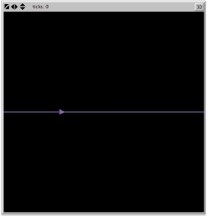
Figure 1: Press the “fd 1” button and the Turtle moves in a line.
Then he turns off that button and presses the other button. This time the turtle stays in the same spot but continuously turns around. He then asks, what happens if I press both buttons? When he does so, the turtle moves in a circle.]
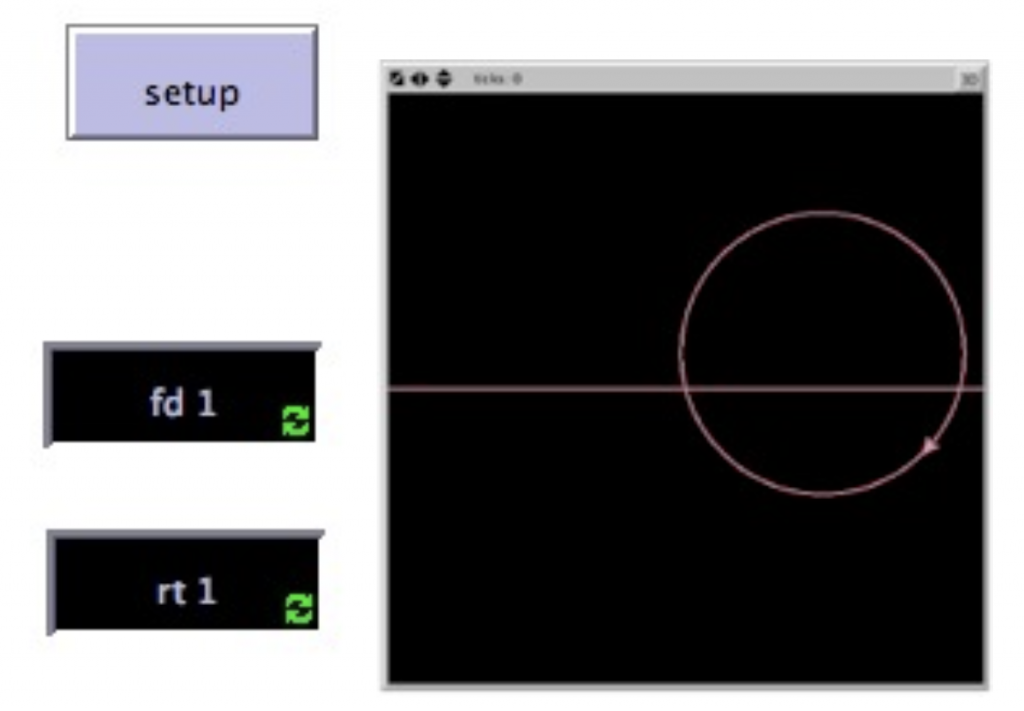
Figure 2: Press both buttons and the Turtle moves in a circle.
This is what I think – it’s kind of dramatic, and I don’t know whether many teachers of mathematics could really explain it. My feeling – when I first saw what it’s about to do, it was an amazing – I think that things like that – we can wonder, you know, about that Turtle with that rotational speed. It’ll pause … it goes in a circle. I understand the circle in a new way because it doesn’t know anything about its distance from a center, it just knows [how to turn] and that’s that. Thank you.
[applause]
____________________________________________________________________
Celia: We are very slightly over time but I just want to say thank you very much,
Professor Seymour Papert, for an inspirational talk. I want to just pull out one thing that
Seymour says, and maybe in the next few days we will all try it. That is, he says, give 10% of our time to thinking about restructuration. Think hard about what mathematics could be for our students, using digital technologies. It is about hard thought on our theme. So 10% of our time in our working groups, in our theory lectures – can we always be thinking that very important message. Thank you very much.
[1] Meaning a regular laptop.