Gary Stager and Constructing Modern Knowledge maintain the online Seymour Papert archives at dailypapert.com. In addition to curating hundreds of articles, papers, speeches, and recordings by Dr. Papert, the father of educational computing, The Daily Papert offers a growing library of classic Logo books and documents the history of 1:1 personal computing in schools.
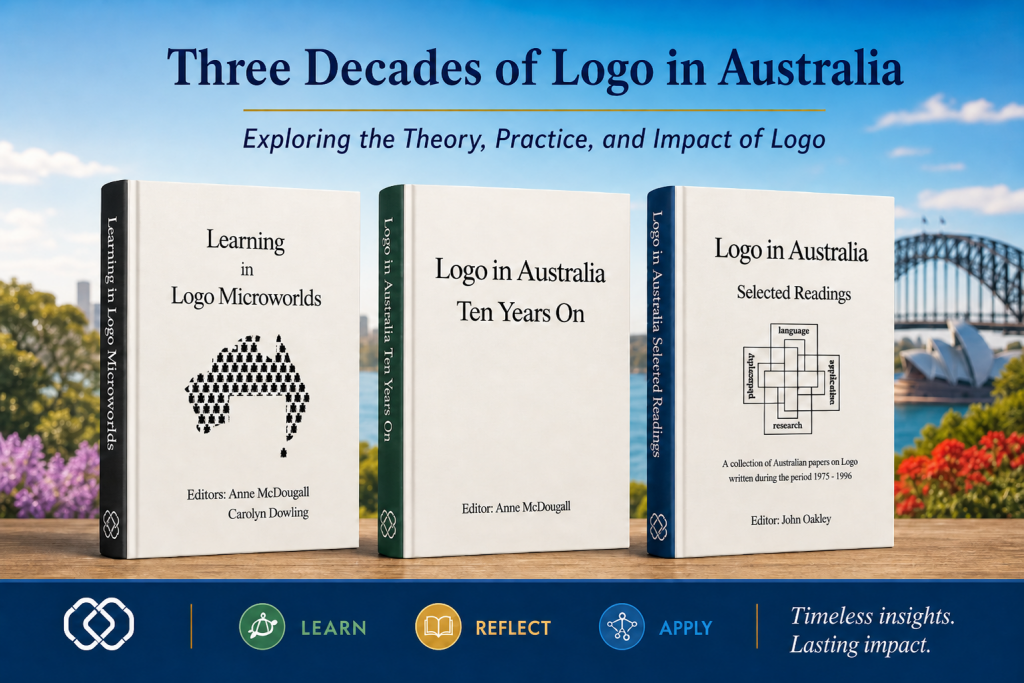
We are proud to preserve and share three books full of seminal essays about Logo in Australian schools, written by pioneering Aussie academics between 1975 and 1997. Check them out at here. While there, you will find many other sensational books to inspire creative computing in your school.
If you use Scratch, Lynx, Snap!, MakeCode, Turtle Art, or any other descendent of Logo, these books offer powerful ideas for your consideration.
About Logo
Developed in the late 1960s by Seymour Papert, Cynthia Solomon, Wally Feurzeig, and colleagues at Bolt Beranek and Newman and later at MIT Media Lab, Logo is far more than a programming language — it is a philosophy of learning. Inspired by the work of Swiss psychologist Jean Piaget, Logo was designed to help children learn by making, experimenting, debugging, and reflecting. Its most famous feature, the “turtle,” allowed learners to control an on-screen or robotic object through simple commands, turning mathematics and computation into concrete, playful experiences. Papert described this approach as “constructionism,” the idea that people learn best when actively constructing meaningful projects and sharing them with others. Although created decades ago, Logo profoundly influenced modern educational computing, from robotics and maker education to languages and environments such as Scratch and LEGO robotics. Its enduring legacy lies in the belief that computers should empower children to think creatively, explore powerful ideas, and become designers rather than mere users or consumers of technology.
Contributing Authors