March 12, 2012
“Instead of making kids learn math let’s make math kids will learn.” Papert, S. (1996). “An Exploration in the Space of Mathematics Educations.” International Journal of Computers for Mathematical Learning, Vol. 1, No. 1, pp. 95-123.
“Instead of making kids learn math let’s make math kids will learn.” Papert, S. (1996). “An Exploration in the Space of Mathematics Educations.” International Journal of Computers for Mathematical Learning, Vol. 1, No. 1, pp. 95-123.
“Geraldine Doogue: What I’m curious about then is out of this fascinating time working with Jean Piaget – who developed that whole notion of the stages of development for children – how would digital technology fit in to what you learned then? Because you’re a great advocate for digital technology being used to help children
Curator’s note: In 1983, The BBC and Open University produced and aired a documentary entitled, “Talking Turtle,” about the work of Seymour Papert and his colleagues, their creation, Logo and a vision of how computers may revolutionize education. There is also a large segment about the groundbreaking (and often overlooked) work members of the Logo
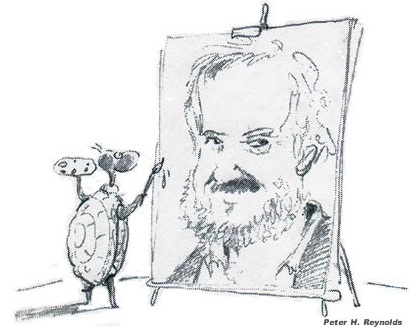
“The essential point about the turtle is its role as as a transitional object. That is transitional between the body, the self and abstract mathematical ideas. The turtle, you can identify with it. You can move your body in order to guess how to command the turtle, so it’s related to you, to the body,
“Plastic robots, arrows on screens, hyperactive sprites all belong to the same turtle family. They all obey the same commands. By getting to know these turtles the way they get to know a person, these children are learning to be mathematicians. This is Piaget’s real message to us – learning rooted in experience.” Papert, S.
“What they teach in school, I like to call, “math,” as opposed to mathematics. Mathematics is one of the great jewels of achievement of the human mind. Math is a bunch of boring stuff that you make kids do with pencils and square papers and filling in numbers. There is no relation.” Jump to 19
“In New York City there is a growing number of classrooms, I believe nearly fifty now, where future and past seem to meet. In the front a chalkboard: a teacher talking, perhaps about sentences, perhaps about ratios, in the middle desks: children sitting, some listening, some dreaming. Familiar. At the back something different. Two computers
“I left Geneva enormously inspired by Piaget’s image of the child, particularly by his idea that children learn so much without being taught. But I was also enormously frustrated by how little he could tell us about how to create conditions for more knowledge to be acquired by children through this marvelous process of “Piagetian
“In 1971 Channel 5, a local Boston TV station, produced a program on children in new learning situations and included a segment on Logo. Here is that segment. My one regret is that Seymour was not talking with a child during the filming. By the way I am indebted to youTube and one of its
“Actually the educational software industry does know best about something, but about something other than the best ways to learn mathematics. It has excellent knowledge about what can be most easily sold to parents. Software that drills the kids in using numbers is easily recognized by the most uninformed parent as “math.” That kind of