March 12, 2012
“Instead of making kids learn math let’s make math kids will learn.” Papert, S. (1996). “An Exploration in the Space of Mathematics Educations.” International Journal of Computers for Mathematical Learning, Vol. 1, No. 1, pp. 95-123.
“Instead of making kids learn math let’s make math kids will learn.” Papert, S. (1996). “An Exploration in the Space of Mathematics Educations.” International Journal of Computers for Mathematical Learning, Vol. 1, No. 1, pp. 95-123.
“But insofar as it can be seen as an aspect of education, it is about something far more specific than constructivism in the usual sense of the word. The principle of getting things done, of making things — and of making them work – is important enough, and different enough from any prevalent ideas about
“In the past most people left the world only slightly different from how it was when they found it. The rapid and accelerating change that marks our times means that every individual will see bigger changes every few years than previous generations saw in a lifetime. So this is the choice we must make for
“LOGO environments are like samba schools in some ways, unlike them in other ways. The deepest resemblance comes from the fact that in them mathematics is a real activity that can be shared by novices and experts. The activity is so varied, so discovery-rich, that even in the first day of programming, the student may
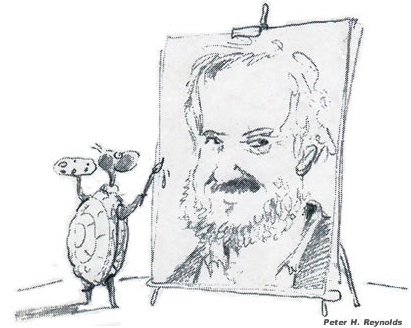
February 29, 2012 – HAPPY BIRTHDAY SEYMOUR!! Read More »
“Geraldine Doogue: What I’m curious about then is out of this fascinating time working with Jean Piaget – who developed that whole notion of the stages of development for children – how would digital technology fit in to what you learned then? Because you’re a great advocate for digital technology being used to help children
Curator’s note: In 1983, The BBC and Open University produced and aired a documentary entitled, “Talking Turtle,” about the work of Seymour Papert and his colleagues, their creation, Logo and a vision of how computers may revolutionize education. There is also a large segment about the groundbreaking (and often overlooked) work members of the Logo
“We do have to think also about content, we do have to think about making another kind of intellectual diet for children, we have to think about them understanding this technology in a deeper way than simply being able to use it, however magical and wonderful and that may be, for access of knowledge and
“The essential point about the turtle is its role as as a transitional object. That is transitional between the body, the self and abstract mathematical ideas. The turtle, you can identify with it. You can move your body in order to guess how to command the turtle, so it’s related to you, to the body,
“Plastic robots, arrows on screens, hyperactive sprites all belong to the same turtle family. They all obey the same commands. By getting to know these turtles the way they get to know a person, these children are learning to be mathematicians. This is Piaget’s real message to us – learning rooted in experience.” Papert, S.
“The best learning is learning that is embraced and enjoyed. Children love to learn until they are taught otherwise. Indeed even then, while most people may hate being taught, I believe that everyone, especially every child, always likes learning.” Papert, S. (1996) The Connected Family: Bridging the Digital Generation Gap. Atlanta: Longstreet Press. page 51.