March 12, 2012
“Instead of making kids learn math let’s make math kids will learn.” Papert, S. (1996). “An Exploration in the Space of Mathematics Educations.” International Journal of Computers for Mathematical Learning, Vol. 1, No. 1, pp. 95-123.
This category describes the time period in which Papert published or spoke the specific quote
“Instead of making kids learn math let’s make math kids will learn.” Papert, S. (1996). “An Exploration in the Space of Mathematics Educations.” International Journal of Computers for Mathematical Learning, Vol. 1, No. 1, pp. 95-123.
“But insofar as it can be seen as an aspect of education, it is about something far more specific than constructivism in the usual sense of the word. The principle of getting things done, of making things — and of making them work – is important enough, and different enough from any prevalent ideas about
“In the past most people left the world only slightly different from how it was when they found it. The rapid and accelerating change that marks our times means that every individual will see bigger changes every few years than previous generations saw in a lifetime. So this is the choice we must make for
“Looking at the complex texture of LOGO development (of which I have mentioned only a sample of what already exists and barely a foretaste of what might come) provides a new perspective on the problem of deciding not only whether LOGO succeeded or failed, but whether all endeavors in the field have succeeded or failed.
“Thus we are brought back to seeing the necessity for the educator to be an anthropologist. Educational innovators must be aware that in order to be successful they must be sensitive to what is happening in the surrounding culture and use dynamic cultural trends as a medium to carry their educational interventions.” Papert, Seymour A.
“This neat picture of successive stages has aroused such strong positive and negative reactions that the ensuing debates have obscured Piaget’s really important contribution: His description of different ways of knowing is far more important than quibbling about whether they neatly follow one another chronologically. And what is especially important is the description of the
“LOGO environments are like samba schools in some ways, unlike them in other ways. The deepest resemblance comes from the fact that in them mathematics is a real activity that can be shared by novices and experts. The activity is so varied, so discovery-rich, that even in the first day of programming, the student may
February 29, 2012 – HAPPY BIRTHDAY SEYMOUR!! Read More »
“Geraldine Doogue: What I’m curious about then is out of this fascinating time working with Jean Piaget – who developed that whole notion of the stages of development for children – how would digital technology fit in to what you learned then? Because you’re a great advocate for digital technology being used to help children
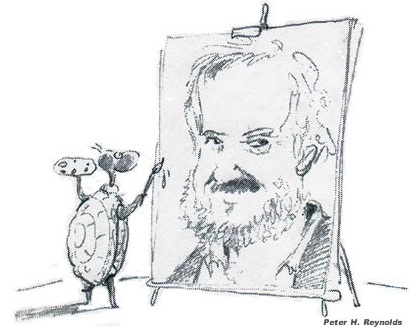
Curator’s note: In 1983, The BBC and Open University produced and aired a documentary entitled, “Talking Turtle,” about the work of Seymour Papert and his colleagues, their creation, Logo and a vision of how computers may revolutionize education. There is also a large segment about the groundbreaking (and often overlooked) work members of the Logo
“We do have to think also about content, we do have to think about making another kind of intellectual diet for children, we have to think about them understanding this technology in a deeper way than simply being able to use it, however magical and wonderful and that may be, for access of knowledge and